Friday, April 26, 2013

Goodbye TCDC and Makumira


For those who know me well, you know that I am a softy, sentimental weirdo. So, on that note, as I start the next phase of my journey, I have a writing that I think is so apt for this time and place. I hope it resonates with some of you. Mad love to you all and remember to always keep it real.

"Crossing that threshold into your uncharted future is an act of great courage and self-compassion, and it changes your relationship to life in a fundamental way. It embodies your willingness to employ a new form of risk-taking, to consciously choose growth-stimulating, soul-nourishing conflicts, to live through the accompanying anxiety, and to accept your life as open-ended and unpredictable. Passing through that door commits you to living in the present in a way you never before have. Your personal, cultural, or religious past no longer provides you with a map to your future."

The internet is only half working so I am not able to upload many pictures. My family made me a cake for my last night! Then we sat around the table and all talked about how much we would miss one another. It was so fun to feel like a part of their family. I will miss hearing their sweet voices every time I walk in the door. Always so much warmth and laughter.


My time here at MS-TCDC has come to an end and I said goodbye to my family today. I went into it knowing that it was temporary. Everything in life is temporary and if you really try to embody that concept, it makes saying goodbye a little easier. However, the connections you make in your life are forever a part of you. That is how I feel about everyone that I have come to know and love here. I carry all of you with me in my heart and so I never feel alone. It's true.


What I love about this place is that it really teaches you to roll with the punches. With that comes the ‘hamna shida’ attitude. Hamna shida, like hakuna matata, essentially means no problem. While it can get frustrating to have things pretty much never run according to plan, it is a good practice in patience and reevaluating what is really important. At home in the states, it is common to pack our schedules so full that you are yelling at the traffic light when it doesn’t turn or you become irritated if you are left more than 5 minutes waiting for someone or something. While I do like structure and routine and efficiency, having to let it all go feels good too. My time here has made me embody that reality.

Another thing that just floors me every time is how incredibly strong the women are here and in the most silent way possible. They just go about their work…gracefully. Work that requires serious physical and mental strength. It requires a resiliency of spirit on a level that most people in developed countries rarely have to call on. The mamas here are badass.

Everywhere you look, whether you are in a rural or an urban setting, you see women carrying very heavy loads of water, food, wood—anything and everything—on their heads. Last weekend I watched this woman, who was probably in her 50’s, take about a 5 gallon bucket, fill it with water from the stream and then seamlessly lift it up to her head without spilling a drop and then, in one fluid motion, she turns and walks in flip flops up this steep, muddy hill…and just continues on with her day. It is absolutely incredible the amount of physical labor that people do in this country.

Another one of my favorite things to do is to say, “Shikamoo” to a mama or a bibi (grandma) who is tirelessly working away. Shikamoo means essentially, “I show you my respect”. The response is, “marahaba”. Their response is one of the most genuine, heartfelt, fully engaged responses you could ever hope to get from a stranger on the road. Just full body smile, followed by some high fives and some laughs. Oh. I am going to miss those exchanges. If you ever feel unsafe or unsure of your surroundings, go find yourself a mama and you will be taken care of.  

Well, this blog post is short and maybe a little disjointed, but this week has been busy and I need to go flag down a bus to Moshi, and I do literally mean 'flag down a bus'. You wait for one that looks like the one you want, wave your arms and scream "Moshi?" to the driver. If they have room...or not, they stop and shove you on. I hope that I have a seat waiting for me.

Okay, ya'll. It's been real and it's been fun and it's been real fun. 

Off to climb Kilimanjaro!!!!!!!!!!!

Love,
Sadie

Wednesday, April 17, 2013

Zanzibar Brings Relief

Nothing like a real island vacation to get the blood back in circulation again. Zanzibar is beautiful.


Zanzibar is technically part of Tanzania, but it feels completely different. Here is a little brief history:
The mainland used to be called Tanganyika. On the 26th of April 1964, Tanganyika and Zanzibar gave up their autonomy to become the United Republic of Tanzania. Since the Union of 1964 the mainland has never had a separate government.  Zanzibar does hold a separate government, but the powers were not transferred to the Union government.

Zanzibar has had many cultural influences over the course of its history. The first round of outsiders were the Portugese. Zanzibar is well known for its spices. The Portugese controlled the trade routes until the mid 1700's. They were thrown out by the Omani Sultanate of Arabic descent. They help power until about the turn of the century when the Brits came in. The large white building on the far right was the Sultan's Palace. I am not sure if it is even used for anything now. 


Okay, enough history. Time for some fun!
So, we stayed at the Jambo Beach Bungalows for $20 a night. It included breakfast. It definitely is not the place to stay if you are looking for peace and quiet, but the people are so nice and friendly and have good tast in music--which is playing all the time. 


The water goes out so far during low tide. So many people come out to work on the exposed sand during that time. I watched them for hours as I lay on the beach trying to figure out what they were doing. 

This woman was digging something up from the sand for hours. I asked around and found out that they bury the fibers on the outside of the coconut. They leave it buried for a few months up to a year and then dig it back up. They dry it out and continue to work with it to make it into rope. Just fascinating.


They mark the fibers that they have buried with sticks. The sticks are only exposed at low tide. 


Women working everywhere...


These ladies were coming back in with the tide. 


We spent our first three nights on Paje beach. It wouldn't be a beach vacation if I didn't include some bikini pictures, right?!

This is me and Natalie


So much sunburn. I stayed under cover mostly. It doesn't matter how many times I put on sunscreen. I am on doxycycline for my anti-malaria pill and it makes you burn. 


Also, men here like to dance. They like to pull you off of your chair, even if you are refusing. This man, who is Maasai, did just that. So I danced with him on the beach.


He got such a kick out of the fact that I could jump repeatedly....so we did. Repeatedly. Until I couldn't jump anymore!


We also took a spice tour. Zanzibar is known for it's spices such as cardamom, turmeric, cumin, ginger, cinnamon, nutmeg, henna, etc. It was cool to see all of them in their natural state. They made us lovely necklaces!


After three nights of relaxing on the beach, we headed into Stone Town, which is the historic part of the larger Zanzibar town. You could really feel the Arabic and Portugese cultural influences in the architecture and carved wooden doorways.

The streets were so narrow.

The doorways were beautiful....


Here is one that is either newer or has been maintained...


We ate at this restaurant totally geared towards tourists, called Mercury's. It is named after Freddy Mercury of Queen. He was born on Zanzibar. It was such a beautiful place to watch the sun set over the Indian Ocean and watch the locals go about their way of life.


Bringing the boats up on the shore is a group effort


These guys were doing repeated backflips for about an hour. It was so fun to watch. 


So, that was our trip in a nutshell. It was a really nice little get away. We were able to take Fastjet, a local plane service, roundtrip for $60. The flight took 45 minutes as opposed to 8 hours on a bus and then a two hour ferry ride, which would have also been more expensive. 

I thought it was time for a more lighthearted, pure fluff post!

See you later! Love, Sadie


Wednesday, April 10, 2013

It Is What It Is


I am really going to miss the sound of the doors that I have to open on the way to the bathroom in my house. Especially at night when all you can hear is the crickets and the sound of the creaking hinges, which are magnified in the dark, concrete hallway. It is pitch black and the concrete is cold under my feet. It’s funny, the things that you get used to. The things that become comforting just because they are a part of your routine and they are familiar. 

The extremities here are just mind-boggling. So often, at the end of the day, I find myself so frustrated. I keep telling myself, “You are just looking at it wrong. You are being too negative, you have to look for the good.” In so many ways, life here is like life anywhere. We all want the same basic things:  a place to call home, a place to rest our heads, to have food to eat, loved ones around us, a sense of belonging, a purpose. Those things are real across the board-for most-and it is what unites us. There are just so many other things that get in the way of that common purpose. It is easy to forget that we all just want the same thing. However, I think an unfortunate reality is that more often than not, we have to compete with one another to get those things. Or at least we think that we have to. Especially here. Chasing the dollar is really what it comes down to. I may be wrong, in fact I hope I am…but I think this is one of those situations where you have to admit to something that you really wish wasn’t true. 

This picture is not really for any purpose other than to show a bit of the normal life...
and break up the text!


I had a nice personal revelation tonight at dinner that lightened my mood. I have been frustrated lately and I will go into more detail about those frustrations in a bit because I think that they are important to share. Not so much as a means of venting, all though writing about them did serve that purpose, but more so because I think that they really help paint the picture of what life is like here. Anyways…back to dinner. So I was eating and I started laughing to myself. I was really enjoying this piece of watermelon. I started laughing because it reminded me of my honeymoon phase with the country, when everything was so brand new. It was exciting and romantic and stimulating and mysterious and the fruit was fantastic! Very much like a new romance. So now I have learned some of the faults of my relationship and I am seeing some of the realities of the life that I am living and it isn’t all pretty or fun and I have to figure out how to compromise or else I am going to go crazy and this relationship is not going to end well. I like to leave on good terms. So Tanzania, let’s start over. Let me remember all the things I wrote about you in the beginning. Let’s rekindle this spark.

First things first, though. Let’s clear the air.

So what frustrates me? Well, corruption, for one. It is a word that gets thrown around so carelessly…but here I have seen and experienced the real meaning of it. The police, for instance. They will pull you over to the side of the road and essentially ask you for money. Sure, they may hide the request in the form of a warning about your vehicle, but instead of writing you a ticket for 10,000 shillings that would actually go to the revenue authorities, they accept small bribes of 1000 to 3000 shillings, or whatever. Almost everyone just accepts it! You ask people about corruption and most just laugh, as if, oh…what can you do? I have been told that the truck drivers just drive around with a good stash of 1000 bills because they know that they will get pulled over multiple times and that is all that the police are looking for. It is easier just to pay them off.

Another place that corruption rears its ugly head is in the education system. The majority of public schools are so underfunded with absolutely no resources. The children have no books. There may be one teacher for every 200 students. Also, all of primary school is taught in Kiswahili and then the language switches to all English once they get to Secondary school. So many struggle to understand the language that they merely memorize instead of actually learn. They aren't able to think critically or expand on a topic. This year, 50% of students failed their Form 4 exams, which is the equivalent of our senior year of high school. If you fail that, you can't go on to college. Your education stops. 

I took these pictures at a local school. Some schools are doing a good job, but the challenges are many. Don't take your education for granted!


Notice the hand drawn map on the chalk board


Also, the mail service. My lovely brother and his family were sweet enough to send me a package. Have I received it? No. If I did, I am sure that they would have charged me just to pick it up. That happened to my program mate, Natalie. They wanted around $70 just for her to retrieve it. Why? Because they can. They said something about how she was receiving things that she could have bought here and it was taking away from their economy, blah, blah, blah. Luckily we knew someone in a high position who could communicate with them and we managed to get the package without payment, but Jeesh! Today I did receive a small package in the mail from my friend and I was not asked to pay anything. However, they had unwrapped the packaging! I do not know if they opened the box and looked inside, but come on!

Another one for the list, as long as I am at it: Immigration. We sent in all of our necessary papers well in advance for our residence permits. They said our photos had to have a blue background, not white. So we took pictures with a blue background. They said it was too dark, so we took another set of pictures. They almost refused those too. We didn’t hear anything for months. They acknowledged that they received what they needed. However, a few weeks later they said that they had lost our files. This is how the bureaucracy works here. It is so hard to get anything done. Thank god we have competent people working on our behalf. The people here see it too. They are also frustrated. But how do you solve such big problems when they are the result of the system that is in place?  It is not only the system, but also the people that are running it. 

There is no system for trash removal or recycling, so people just pile it up and burn it in the streets. 


Okay, I have to do one more, because it has really stuck with me. The other day we were in Moshi. A nice town about an hour away. We went specifically to visit this artist who specializes in a specific style of painting, called Tinga Tinga. We had met him previously and were walking to his shop. We were getting close; literally a few hundred meters away, and a man approaches us to “help us find our way”. This is common when you are walking anywhere in a bigger town. Normally you exchange a few nice greetings in Swahili, you say ‘no thank you’, and they leave you alone. This guy continued to walk with us, acting so helpful, so we just laughed and walked with him because we were going in the same direction. He wanted us to go to his friend’s shop, which was a few doors down from Kimambo, the man we were visiting. We told him that we were only going to our friend’s shop. We thanked him and even gave him a little money. Well, the whole time we were in the shop, he stood in the doorway and glared at us. Both Natalie and I told him that he didn’t need to wait for us and thanked him for his time. When we left, he followed us. He continued to hassle us and got more aggressive and unpleasant. Austin was talking to him and I could hear him getting more aggressive, so I stepped in. Maybe I shouldn’t have, but I had had it with this guy. I was stern with him and just asked him what he wanted and told him that we never asked for his help but that we gave him money anyway and that he needed to leave us alone. The whole time he was glaring at me and then he snarls, while staring in my eyes, “Women in my culture do not rise above the men.” I actually thought that he was going to hit me. That phrase though…that has stuck with me. That attitude is the root of the gender inequalities and gender roles, which are very strong here. I have been asked many times why I am not married and why I don’t have children. A woman is not seen as a woman until she has had a child. Of course there are men here who love their wives and their daughters, but the stereotype of a woman’s role in society is so incredibly evident and ingrained in the culture. It just makes me feel so sad and so infuriated at the same time. It makes me want to never get married or have children and become wickedly successful just to spite them…but I won’t let them get the best of me.

There are too many other beautiful things to be had......

So, I apologize if this post was more geared towards the negative side. I am trying to show a bit of both sides. This is what I am learning. I don’t know…maybe on my month of solo travel, I will have all sorts of amazing, eye-opening, heart-opening experiences that disprove all of what I have written. I hope so. I want to believe in the goodness of others. Life is just very different here. They have grown up with different realities than I have. That has inevitably shaped how they relate to their world. It is perhaps something so deep that I will never be able to understand. I can theorize about it, but I will never be able to relate on a core level. I know that poverty, extreme poverty, has a lot to do with it. Maybe everything? I am a foreigner in a foreign land with a foreign language with a foreign culture and I am just trying to make sense out of it all. It’s still pretty cool that I am here. Sometimes I just stop and say to myself, ‘holy crap, I’m in Africa.’

There is a saying that I have been contemplating lately:

“Our calling is where our deepest gladness and the world’s hunger meets.”

                 -Frederick Buechner

Travel sure is a good way to explore things of that nature. 


Here's a picture of me for my beautiful parents. The whole reason I started this blog in the first place because they are too cool for facebook!


There is a certain type of freedom and chaos here that is really beautiful. It is hard to put my finger on, but it flows through the veins and it is a subtle feeling. If you are able to give yourself to it, it is really intoxicating in a mysterious way. 

All right Tanzania, let’s fall back in love. Ready. Set. Go!

Tuesday, April 2, 2013

Fundraising for my solo travels

It is true. I have decided to hold a fundraiser for my month of solo travels. This is an exceptional experience, but it also happens to be rather expensive, especially when you have no income!

So far my plans for the month of May are to climb Mount Kilimanjaro and visit the Serengeti.
I am also researching a trip to the Western side of the country to visit Gombe National Forest where Jane Goodall studied Chimpanzees. It would include over 20 hours of bus rides, but hey, that's travel right?!

See my link below for more details.

Any help is appreciated.

Learn By Exploring Fundraiser

As always, I hope this finds you well.
Much love,
Sadie

Thursday, March 28, 2013

One Side of the Coin


Look, here’s the truth. Sometimes it is hard being here. I wish that I could tell you that everyday is amazing and inspirational, but frankly a lot of the days are extremely draining.
There are so many challenges here and life can often be uncomfortable. The problems can get overwhelming. I am, by nature, a sensitive person.  I also like doing. I like answers, communication, solutions, clear understandings and I like fixing things…it is so hard to find the answers here. Especially when you barely speak the language. It is also a challenge to know how or what to do to make any sort of difference. Where are my tools?! It seems at times as if there is no way out. I feel ineffectual and useless and it is driving me mad!

At the beginning, I was in awe of the landscape and the people and all the different ways of interacting with and experiencing my environment. Now I have moved more into the day-to-day reality of life, the day-to-day reality of life in Africa. Coming from the lens of my experience growing up in a first world country, it can be downright shocking at times…and I consider myself a laid back person!

I have been immersed in learning about the bad: the gender inequalities, the dismal health care system, the corruption, and the lack of infrastructure—just to name a few. I know that somewhere amidst all of the struggle and injustice is resilience and love and progress. So many times I have read about these things in books, but here…after learning about it…I go step out into the world and am surrounded by the reality of what I have been reading about for so long. I am in that book about poverty. I am in that book about gender inequality. I am in that book about maternal mortality. I am in that book, but what character am I? What can I do? I can often sense the acceptance of defeat around me and I don’t blame them. Don’t get me wrong; people are not blind to the problems here. There are many intelligent and educated people, especially at MS-TCDC, who love their country and their people and are actively working on finding solutions towards sustainable development and a higher quality of life for everyone.

I have been thinking a lot about Maslow’s Hierarchy of needs in relation to the day-to-day lives of people here in Tanzania. One of the things that has been eating at me is that so many people here are still struggling for the basics: shelter, food, water. Being stuck at that level of existence is keeping them from self-actualization and other intellectual and emotional aspects of life that come after you have secured the basics. However, we are still emotional beings, so how does that emotion manifest itself? What form does it take? I can’t imagine that they are on the emotional repeat of just simply being happy or sad whether or not they have had enough to eat for the day. They still are living in a world made up of human relationships. They still have eyes that can observe their world and a nose that can smell the sewage, car exhaust and burning trash and ears that can hear the feral dogs and incessant honking of the traffic. How does this resonate on an emotional level? Or is it perhaps just so normal that it fails to activate the senses? I do believe that a person can find peace and acceptance no matter what their living condition is, no matter what their lot in life may be. At times I think that acceptance of the situation is the problem standing in the way of growth and progress. Complacency and disenchantment are at the root of stagnation. However, in some situations, it seems that acceptance may be a justifiable means to finding peace with the situation that you are in. Sometimes you just gotta do what you gotta do.

It is so hard not to look at the way of life here and make comparisons through the lens of life back home. I am trying so hard not to be too ethnocentric in my observations and opinions of what I am taking in. I feel like I need to observe and learn before I can make any relevant criticisms. I have been trying to avoid writing about how frustrating life here can be. I feel as if it is somehow a critique of the people that have welcomed me into their homes and their lives. It is not, or perhaps it is, but that is not my intention. I just feel like I am receiving so much stimulation in so many forms and it has to go somewhere. So, the page is a fairly benign place to put it.

I am not here by accident. I made this happen. I wanted to be uncomfortable. Really. I did. And I still do. I am still glad that I am here. It is an amazing opportunity to experience a country and a culture in the way that I am. I wouldn’t have it any other way. I wanted to know more. Sometimes you don’t like what you learn. The unfamiliar is only unfamiliar until it becomes familiar. I think part of the pain and confusion is born from my perspectives being challenged. I am learning and experiencing things about the world that I wish didn’t exist. Thanks for putting up with me. I will continue doing what I do. Also, I am not uncomfortable all the time! Far from it. This is just one side of the coin…or one side of a 14 sided die!

Personal messages are also appreciated. I realize that you all have your lives going on back home and you have your own struggles, stresses and obligations, but hearing from loved ones never gets old. Believe it or not, I still wonder about you all.  
Connect with me on facebook or email: sadiegannett@gmail.com

Now I am going to go join my family for dinner. I can hear my brothers laughing. I’m gonna go see what’s so funny. 

Experiencing the Maasai


The part of Tanzania that I am living in has a large population of the Maasai tribe. A few weekends ago, one of our teachers, Mackrine, took us to visit and stay overnight at a Maasai village. It was an incredibly unique opportunity to have an invitation such as this. It is common for tourists to visit Maasai villages on arranged safaris, but I question how genuine of an experience those are as they are geared towards receiving tourists and essentially putting on a “show”. This particular village has been working with Mackrine and her organization in regards to ending female genital mutilation. They have agreed to end the practice in their village. Mackrine’s approach to gaining access and opening the dialogue with the Maasai has been to compensate and empower the women for their willingness to change their cultural practices. She does this through education and also each woman who agrees to give up the practice of performing the circumcision is given three sheep. Traditionally women are not allowed to own animals.
The women were so happy to see Mackrine. She is on the far left in the purple dress.


We still got quite a show. This is how the women greeted us, singing and dancing all the way...


Jumping is a part of their traditional dance


Culturally, the Maasai are very rich, however, if you were to look at their way of life from a western perspective, you would see them as extremely impoverished. Their possessions are few. Extremely few…in fact, they seem to not have possessions except for the clothes on their back and their beautiful jewelry that they make. However, if you were to ask them, they see themselves as very rich, because they have cattle and goats. That is their bank account. They live with the land. Their furniture consists of a bed, often shared by many, and some small carved wooden stools. 

In this picture is the bed in the hut of the youngest wife. The bed and a single candle were the only things in the huts that we saw. It is possible that they put away some of their belonging for our visit, but I can't imagine many more possessions as they are traditionally a nomadic culture. We slept in this hut but none of us felt comfortable taking her bed. They gave up many of their huts for us to sleep in. We are not sure where they slept...


Their shelter is traditionally a mud hut constructed out of sticks and mud with a thatched roof. The mud is similar to a cob mixture. What I observed was a mixture of clay, ash and water. The sticks are woven together and then mud is applied to the sticks. Each wife builds her own hut and that is where she sleeps with her children. It is a polygamous culture so the husband chooses which wife he will sleep with and if she is chosen, he will come to her hut. 

Here is an example of the women showing us how they apply the mud to the stick structures. They really got a kick out of watching us do it. One of the female guest in this picture is disabled. I will talk about that later on. 


This woman kept smiling at me. She is beautiful. 


And here you go...a finished hut. We slept in one of these huts. 


For our visit, they slaughtered a goat. I learned that on a daily basis, the Maasai eat very little. They may just have one meal a day of porridge. I know that they drink the milk and the blood of the cow, however, I am not sure if that is part of their daily diet. My assumption is that milk would be part of their daily consumption, but my assumptions have often been wrong. They collect blood from the cow by piercing a vein in the neck and then they cover over the wound with mud. It is rare that they actually kill a cow or goat. I was told that they may do it about once a month. When we were there, they slaughtered a goat for us to see. 
Traditionally, women are not allowed to witness the killing or the butchering. However, since we are form a different culture, they let us watch. I did not see the whole process, so my pictures are limited. They killed the goat by suffocation. I am assuming this was to keep the process cleaner and conserve the blood for drinking. They then moved the goat onto this bed of leaves to keep it from the ground. There is so much dirt and dust in this part of the land.


This one Danish woman really wanted to try her hands at the slaughtering. I think that it was a learning experience for both. I wonder what it was like for the Maasai men to see a woman doing something that is forbidden in their culture...


Yes. They do eat all of the goat. Organs, blood and all. At the time of the slaughter, they ate the lungs and liver and other organs raw along with drinking the blood, which they added salt to. 
Our teacher brought along our own cooks and food since our diets and way of eating are so different. They cooked our food over this trench of fire.  


Another aspect of this trip was that Mackrine works with disabled people. It is believed in the Maasai culture that if a person is born with a disability that they are cursed and they are not welcomed into the community. Mackrine works with a folk school in Denmark and part of what they do is work with people with varying degrees of disabilities. She organized an 11 day trip (I think) for them to come and learn about Tanzania. They came along to the village with us. I believe that there were about 6 disabled people. Each person had one to three attendants depending on their degree of disability. It was very interesting to observe the Maasai interacting with people that their culture casts out. 
The man in this photo was not born with a disability, but he got into an accident later in life which left him with brain damage. He was very mobile and could communicate fairly well. 

I am not sure what disability this woman had, but she was unable to communicate and was dependent on her wheel chair. She was surrounded by the Maasai. 


After the slaughtering of the goat, Natalie and I took a look at their jewelry. Well....it was not a casual 'just looking' sort of thing because multiple women surround you and just start putting jewelry on you. This is a good picture that shows the extent of adornments that they wear. The beaded collar signifies that a woman is a wife.


Here is their jewelry displayed...


Here I am being, somewhat willingly...okay...willingly, adorned. It was just too cool so I decided to give myself to the situation. It is good to know when not to resist. 


TaaaaaaDaahhhhhh!!!!!


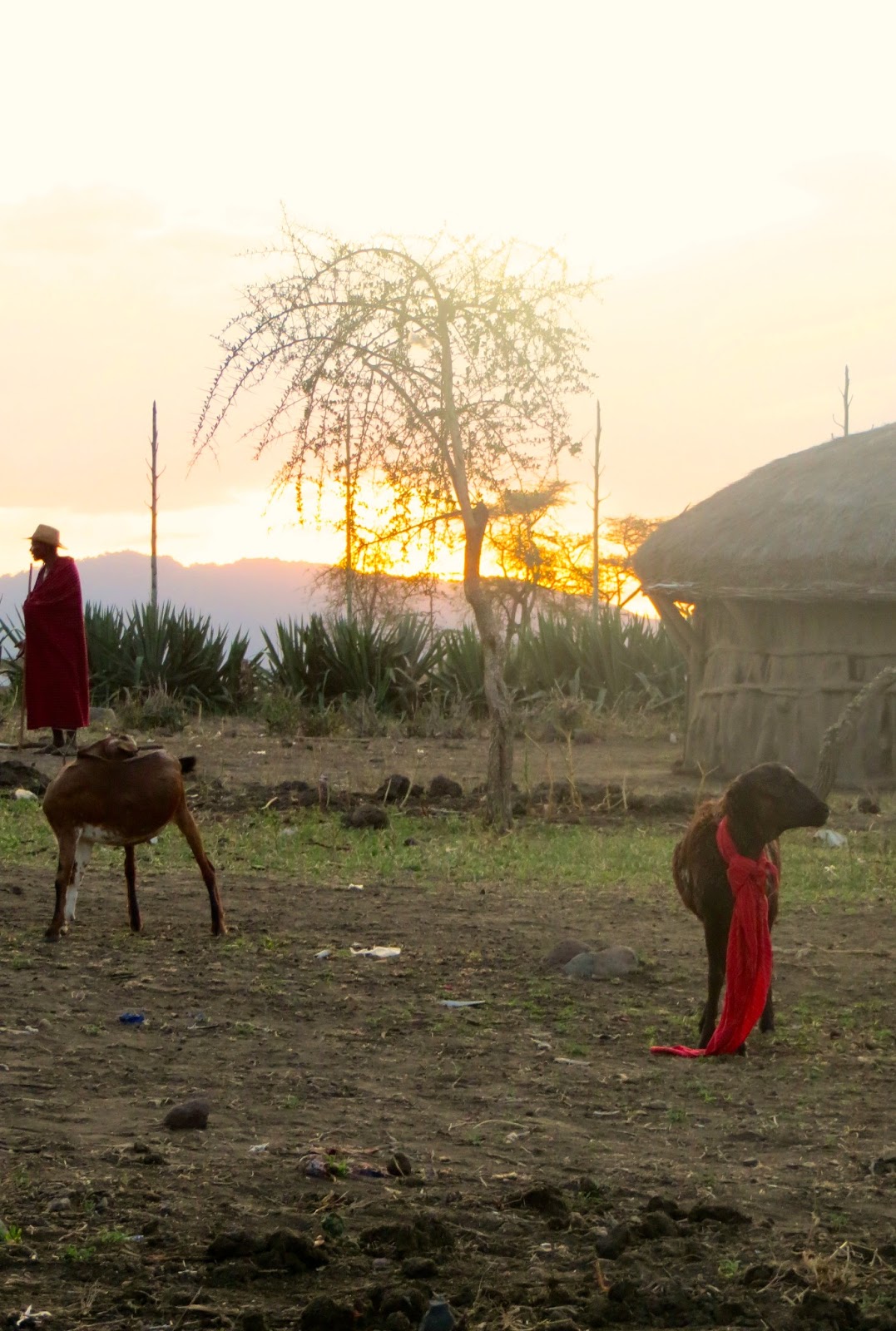
As the sun was setting, the scenery just got more dreamlike. It was such a trip to just sit back and observe such a different way of life. I just want to share some pictures of that...

Here is a woman and her sheep.

Just hanging out...


A young Maasai man in the foreground...the 83 year old chief in the background...


Two old goats....

I believe that the man on the right is the chief's oldest son. He was herding the goats for the night. 


As the sun set, the outline of the huts looked so cool


Here they are roasting the goat around the fire. You can see the Maasai men leaning on their sticks on the right. 


And...this is where we slept. To be honest, none of us really slept. I am not sure why...we were sort packed like sardines and weren't quite warm enough...but so be it. It is all part of the experience. 


So that was our visit. It sure was an interesting way to get a closer look at a culture that has such a different way of life.  
  It is hard not to look at the ways of the Maasai culture and see the extreme gender violence and oppression towards women. They face genital mutilation, they are told when it is their turn to have sex with their husband, they are not allowed to own animals, they are not allowed to slaughter or witness the slaughter of an animal, they are not allowed to speak at meetings, they are not allowed to have any part in the burial if a child if one dies. It goes on and on. Men are seen very much as superior to women. It is a hard pill to swallow. I also have to remind myself that it is dangerous to make across the board stereotypes and judgements about an entire culture. The answers are not simple.
However, there is still something beautiful about the Maasai. There is an extreme simplicity to their way of life. They seem to get genuine joy from living with the land. There is something romantic about how untouched their culture remains to this day when we life in an ever globalized world. 

If you would like to see the whole album, click on the title below: